Rinnai code 12: why the flame goes out, and what to check
Why It Stopped editorial team, updated
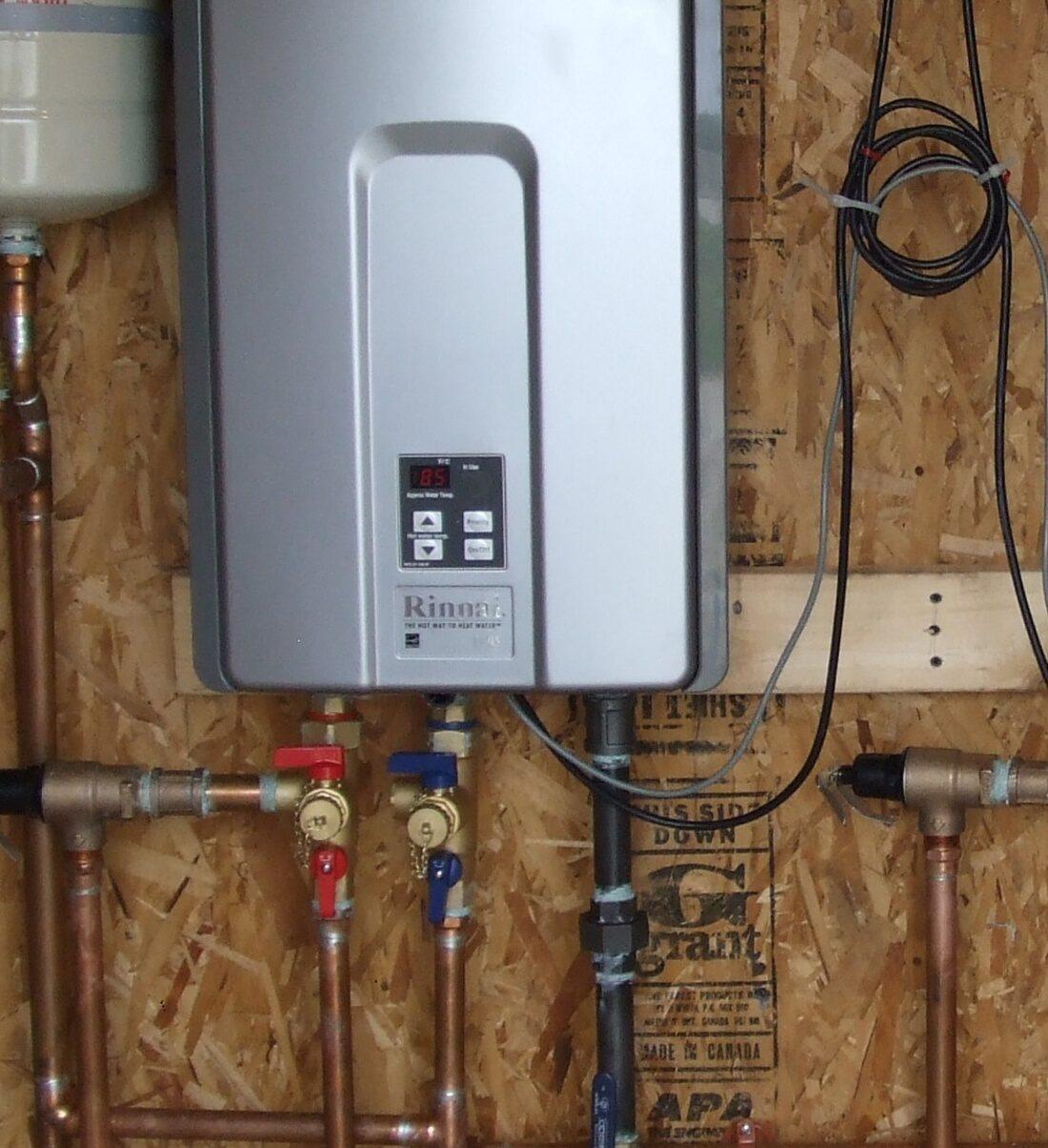
Code 12 on a Rinnai tankless water heater is flame failure: the unit lost its flame, or stopped being able to detect it, and shut down. Rinnai's checklist starts where code 11's does, with the gas supply, but code 12 leans harder on two things a homeowner can actually spot: gas pressure that sags when other appliances run, and a vent outside that lets exhaust drift back into the air intake. The rest (flame rod, wiring, grounding, the gas valve) is technician work.
What code 12 means
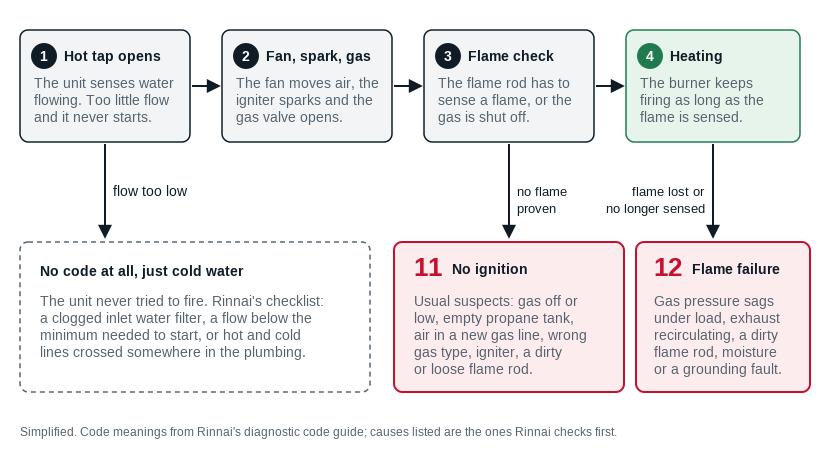
Rinnai's diagnostic guide names code 12 Flame Failure; the owner's manual lists it as No Flame. A gas tankless heater keeps checking its flame with a sensor called the flame rod for as long as it's firing. When the flame isn't there, or the rod stops detecting it, the unit closes the gas valve and shows 12.
The closely related code 11 means No Ignition: the burner never lit, or never lit in a way the unit could confirm. The two share causes (gas supply, a dirty or loose flame rod), so if your history shows both, read both.
We're not affiliated with Rinnai. Everything below comes from Rinnai's manuals for its US tankless models; check the manual for your model, since details vary between series.
When does it happen? That's your best clue
Before calling anyone, note the pattern. It points at different causes in Rinnai's checklist:
| When code 12 appears | Most likely direction |
|---|---|
| During heavy use: several taps, a bath filling, other gas appliances running | Gas supply can't hold pressure at full fire |
| After snow, or since something was built or grown near the vent outside | Exhaust recirculating into the air intake |
| Randomly, at any flow | Flame rod, wiring, moisture or grounding |
| Instantly when a tap opens, with no flame at all (Sensei models) | An electrical short in a component |
| On propane, with the tank running low | Not enough propane |
Checks you can do yourself
1. Gas on, propane in the tank
Rinnai's owner's manual starts code 12 with the same checks as code 11: make sure the gas is turned on at the water heater, the gas meter or the cylinder, and on propane, that there's gas in the tank.
2. Test it with and without other gas appliances
Rinnai requires the minimum inlet pressure on the rating plate to hold with all gas water heaters at the location firing on high fire, and says an undersized gas system is a likely cause when it doesn't. The furnace, dryer and range draw from the same supply, which is why this simple test includes them. You can't measure pressure without a manometer, but you can try this:
- Open one hot tap with the furnace, dryer and any other gas appliance off. Does the heater run?
- Then open several hot taps with those appliances running. Does code 12 appear?
If it only fails under the second condition, tell the technician or your gas supplier. Rinnai's guide says the cause can be anywhere in the supply: the gas piping, the regulator, the tank, the utility supply, or dirt and debris in the system.
3. Look at the vent outside
This is the cause most specific to code 12. Rinnai's guide says a vent termination that doesn't meet the required clearances lets combustion gases recirculate, which can cause incomplete combustion and a code 12. In practice, look for:
- Snow, leaves or a nest at the termination.
- Something new close to it: a deck, a fence, an enclosure, a shrub that's grown up.
- Another vent terminal (a furnace, a second water heater) close by.
Clear what you can. Anything about the vent's position, length or materials is for the installer, since Rinnai's clearance rules come from its venting instructions.
4. Reset once and record the history
Turn the heater off with the On/Off button and back on, then try a hot tap. If 12 comes back, stop resetting and pull the code history: on Rinnai's RSC Sensei models, turn the unit off, press and hold On/Off for 2 seconds, then press Up at the same time, and the last nine codes flash in turn. Other series may differ. A technician will want to know whether it's been 12 every time or a mix of 11 and 12.
What the technician checks
Rinnai's code 12 procedure, for trained professionals, covers these points:
- Inlet gas pressure at the test port with all gas appliances firing. On a properly sized black iron system, Rinnai allows a drop of about 0.3 inches of water column on natural gas and 0.5 inches on propane; more than that means the supply is likely undersized.
- Venting. Clearances at the termination, equivalent vent length, approved materials, and on Rinnai's concentric or common vent systems, whether each joint is fully pushed together. Rinnai warns that joints that aren't fully engaged can cause code 12 through recirculation.
- Flame rod and igniter. Both must be tight in their bracket; the electrode gap is set to 3.5 mm. The flame rod wiring is checked for loose or damaged connectors, and its silicone sleeve for cracks: Rinnai says a damaged sleeve can let the spark find a ground outside the combustion chamber.
- Grounding and polarity. Rinnai calls a properly grounded circuit critical and says to bring in a licensed electrician if there's any doubt.
- The fan. Debris or insects in the blower wheel, and if found, the whole intake air path and vent.
- Propane regulators. A two-stage regulator at least six feet from the heater, and no pressure creep above 10 inches of water column on natural gas or 13.5 inches on propane when the heater shuts off.
- Moisture. Damp or wet wiring connections can short a circuit; Rinnai says to dry them and find the source.
- Gas valve last: condensate, debris or a mechanical fault inside the valve can keep it from working.
On Sensei models, an immediate code 12 (or 19) with no flame visible gets a different approach: Rinnai describes it as an electrical short in a DC component and has the technician unplug components one at a time: when the heater cycles normally with a part unplugged, that part holds the short.
When to call a pro
For the routine upkeep a tankless unit needs (flushing, filters, a yearly check), see tankless water heater maintenance. If the unit won't light at all, read Rinnai code 11. All topics: water heater troubleshooting.
Questions people ask
What does code 12 mean on a Rinnai water heater?
Flame failure. Rinnai's diagnostic guide calls it Flame Failure and its owner's manual lists it as No Flame. The unit didn't hold a flame it could detect, so it shut the gas off. It's different from code 11 (No Ignition), where the burner doesn't light in the first place.
How do I clear code 12 on a Rinnai?
Turn the heater off with the On/Off button on the controller, turn it back on and open a hot tap. That clears the code but doesn't fix the cause; if 12 comes back, note when it happens (at high demand, randomly, or instantly) and work through the checks or call a technician.
Why does my Rinnai show code 12 only when several taps are running?
High demand means high fire, and that's when the gas supply is tested hardest. Rinnai requires the minimum inlet pressure to hold with every gas appliance in the building firing at full rate. A meter, regulator, pipe or propane tank that's too small can let the pressure drop and the flame fail. That's a gas supply problem, not a heater problem.
Can a vent cause code 12?
Yes. Rinnai says a vent termination without the required clearances can let combustion gases recirculate into the air intake, causing incomplete combustion and code 12. Vent joints that aren't fully engaged on concentric or common vent systems can do the same. Snow, a new deck or enclosure, or another vent too close can all create the problem.
My Rinnai shows code 12 the instant I open a tap. Why?
On Sensei models, Rinnai says a code 12 that appears immediately after water starts flowing, with no flame visible in the burner box, points to an electrical short in a component such as a wiring harness, the water flow control or the bypass valve. A technician tracks it down by unplugging components one at a time.
Sources
- Rinnai: Troubleshooting Tankless Water Heater Diagnostic Codes (PDF)
- Rinnai: RSC SENSEI Tankless Water Heater Installation and Operation Manual (PDF)
Written by the Why It Stopped editorial team from the manufacturer manuals and safety guidance listed above. It covers checks a homeowner can do safely; gas lines, refrigerant and sealed components are work for a licensed technician. See our editorial policy and safety disclaimer.
Other water heater problems
Electric water heater not heating: breaker, reset button, elements
No hot water, or not enough: breaker, red reset button, upper vs lower element, thermostat, sediment.
How long do water heaters last, and how to tell yours is near the end
Lifespan by type, how to read your heater's age, warning signs, and the repair-or-replace rule of thumb.
Why your water heater pilot light keeps going out
Lights, then dies: timing points to the thermocouple, drafts, a dirty pilot or the gas supply.
Water heater pilot light won't light: what's stopping it
No flame at all when you try to light it: gas supply, igniter, clogged pilot or a tripped safety device.
Pilot light is on but no hot water: why the burner isn't doing its job
Pilot burning, water cold or lukewarm: the main burner, the temperature dial, gas pressure, demand or the dip tube.
Rinnai code 11: why your tankless water heater won't light
No ignition: gas off or low, empty propane tank, air in a new line, wrong gas type, then igniter and flame rod.
Tankless water heater maintenance: what it needs and how often
Descaling once a year (more in hard water), inlet and air filters, vent checks, and what to leave to a pro.