Rinnai code 11: why your tankless water heater won't light
Why It Stopped editorial team, updated
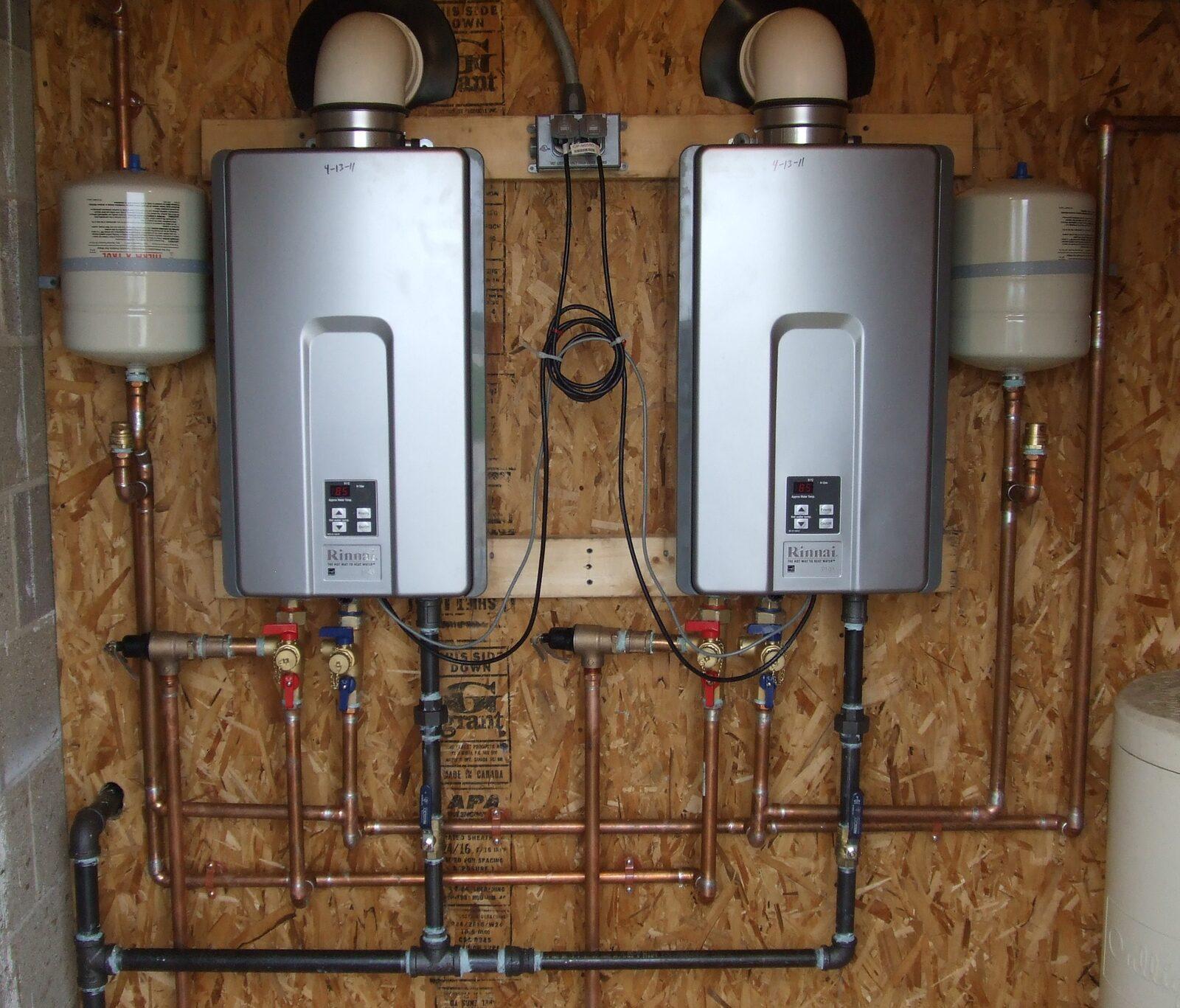
Code 11 on a Rinnai tankless water heater means no ignition. The unit tried to light its burner and never got a flame it could confirm, so it shut the gas off and stopped. Rinnai's own checklist starts on the gas side: a closed valve, an empty propane tank, air left in a new gas line, or the wrong gas type or pressure. Past those, the usual suspects are the igniter and the flame rod, which are technician work.
What code 11 means
Rinnai's diagnostic guide names code 11 No Ignition, and its owner's manual adds "Heater Not Turning On." Every time you open a hot tap, a gas tankless heater runs the same short sequence: it senses water flowing, sparks the igniter and opens the gas valve, with its fan supplying combustion air. Then a sensor called the flame rod has to detect a flame. If it doesn't, the gas is shut off and the display shows 11.
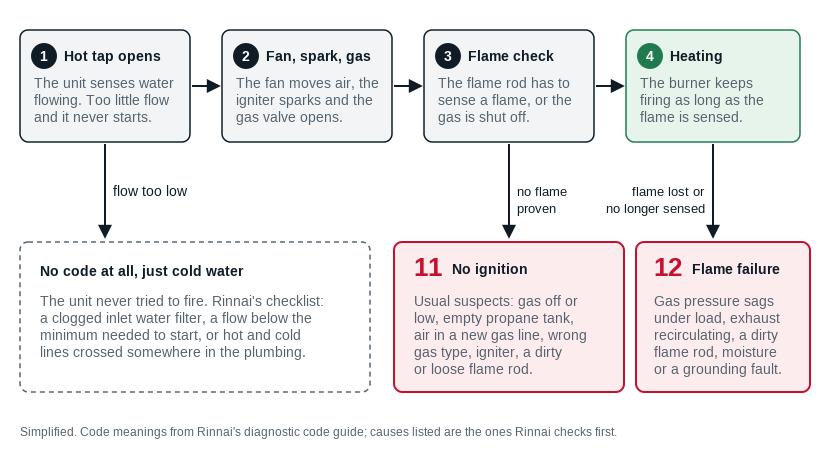
That gives code 11 two broad causes:
- No flame at all: no gas, not enough gas, the wrong gas, or no spark.
- A flame the unit can't see: the burner lights, but the flame rod doesn't register it, so the unit acts as if it never lit.
If the display shows nothing and the water just stays cold, that's a different problem: the unit never tried to fire. Rinnai's checklist for that case starts with the inlet water filter and the minimum flow needed to start (0.4 gallons per minute on its RSC Sensei models), which our tankless maintenance guide covers.
We're not affiliated with Rinnai. Code numbers and steps here come from Rinnai's own manuals for its US tankless models; check the manual for your model number, because details vary between series.
First: if you smell gas
Rinnai's instructions are clear: don't try to light any appliance, don't touch electrical switches or use a phone in the building, leave and call your gas supplier from a neighbor's phone. If you can't reach the supplier, call the fire department. Don't troubleshoot code 11 with a gas smell in the room.
Checks you can do yourself
Rinnai's owner's manual lists the code 11 checks and warns that some of them need a trained professional. These are the ones a homeowner can safely look at.
1. Is gas reaching the heater?
Rinnai's first step is to check that the gas is on at the water heater, the meter, or the cylinder.
- Other gas appliances. If the stove or furnace won't light either, the problem is upstream: the meter, the utility or an empty tank.
- The shutoff at the heater. There's a gas valve on the pipe feeding the unit. A lever handle in line with the pipe is open; across the pipe is closed. If anyone has worked on the plumbing or the heater recently, check it hasn't been left closed.
2. Propane: is there gas in the tank?
On propane, Rinnai's checklist says to make sure there's gas in the tank, and its technician guide adds that the tank has to be properly sized for the job. Check the tank gauge. If other propane appliances run but the heater shows 11 at high demand, the tank or regulator may not be keeping up, which is a question for your propane supplier.
3. Is this a new installation or new gas work?
On a brand-new heater, air left in the gas line is one of the first things to rule out. Rinnai lists bleeding all air from the gas lines among its code 11 fixes, and its technician guide makes "verify all air was purged from gas lines after installation" an early step. If the code started right after installation or gas line work, call the installer back.
4. Does it fail only when other gas appliances run?
Rinnai is strict about gas pressure: the minimum inlet pressure on the rating plate has to hold with every gas appliance in the building running at full fire. A supply that's fine when the heater runs alone can sag when the furnace, a dryer or a second heater fires at the same time. If code 11 shows up mostly during heavy use, tell the technician; the fix is in the gas supply (meter, regulator or pipe size), not in the heater. A sagging supply is also a classic cause of code 12.
5. Does the gas type match?
The rating plate on the side of the unit says whether it's built for natural gas or propane. Rinnai's guide checks that it matches the gas actually supplied, and that the unit's gas type setting was selected correctly. A heater moved from one house to another, or converted, is the usual way this goes wrong. A mismatch is a job for a technician; never try to adjust the heater's internal gas valve: Rinnai says it doesn't need adjusting and that adjusting it voids the warranty.
6. Condensing models: the condensate line
On condensing units (the high-efficiency models with a plastic vent and a drain line), Rinnai's owner's manual lists "ensure condensate line is not blocked" under code 11. Its technician guide explains that if the condensate line clogs or freezes, condensate backs up into the trap inside the unit and shuts it down. Look for a kinked, crushed or frozen drain line. If the unit has a condensate pump, Rinnai uses a separate code (25) when that pump fails.
7. The vent outside
Rinnai's technician checklist for code 11 includes the vent system and debris or insects in the burner and air chambers. You can't open the unit, but you can look at the vent termination outside: a nest, leaves, drifted snow or anything stacked against it is worth clearing.
8. Reset once, then look at the history
Turn the heater off with the controller's On/Off button, turn it back on and open a hot tap. If the cause was temporary (a gas valve someone reopened, a refilled tank), it'll fire. If 11 returns, stop resetting.
On many Rinnai controllers you can see the last nine codes. Rinnai's manual for its RSC Sensei models gives the sequence: turn the unit off with On/Off, press and hold On/Off for 2 seconds, then press the Up button at the same time. The codes flash one after another; the same buttons take you back. Write them down for the technician. Other series may use a different sequence, so check your manual.
The view window test
Rinnai's guide asks the technician to look through the unit's view window while it tries to light. You can do the same if your model has one, and it tells you a lot:
- You see a flame, but it still fails with 11. The burner lit; the unit can't confirm it. Rinnai points to the flame sensing circuit: carbon or a white substance on the flame rod, a loose ("floating") flame rod, a bad connection, the control board, the gas valve, or low gas pressure.
- You never see a flame. No gas or no spark. The gas checks above, then the igniter.
Either way, mention it when you book the visit. It narrows down the parts the technician needs to bring.
What the technician checks
Rinnai's diagnostic guide for code 11 is written for trained professionals, and it covers a lot of ground. In rough order:
- Gas pressure under full load. A manometer at the unit's test port, with every gas appliance firing. Rinnai allows no more than about a 0.3 inch water column drop on natural gas and 0.5 inch on propane on a properly sized black iron system; more than that suggests an undersized supply.
- Propane regulators. A two-stage regulator should be at least six feet from the heater, and the pressure at shutoff must not exceed 10 inches of water column on natural gas or 13.5 inches on propane.
- Gas type and altitude settings on the control board, and the right gas orifice.
- The igniter. A spark test, the electrode gap (Rinnai specifies 3.5 mm) and the wiring to the ignition board.
- Flame rod and igniter mounting. Both must be tight; Rinnai says a loose ("floating") flame rod will result in code 11. They're removed, cleaned of carbon or white deposits and refitted with a new gasket.
- Burner and combustion chamber. Clogged gas orifices, insects or debris in the burner and air chambers, buildup between the heat exchanger fins.
- Venting. Correct materials, length within limits and proper clearances at the termination.
- Moisture. Water in wiring connections, and on indoor units, moisture in the small tube between the combustion chamber and the gas valve, which Rinnai treats as a reason to replace the gas valve and look for a venting or heat exchanger leak.
- Gas valve or control board last, after everything above checks out.
Other Rinnai codes you might see
| Code | Rinnai's name | What it points to |
|---|---|---|
| 10 | Air supply or exhaust blockage | Blocked vent or air intake, a full condensate trap, fan problems |
| 11 | No ignition | This page |
| 12 | Flame failure (No flame) | Flame lost: gas supply, venting, flame rod, moisture. See Rinnai code 12 |
| 14 | Heat exchanger overheat | Can be scale blocking the heat exchanger; Rinnai's fix includes a flush. See tankless maintenance |
| LC | Scale buildup | The heat exchanger needs flushing. See tankless maintenance |
When to call a pro
The fixes on Rinnai's list range from correcting the gas supply to a cleaned flame rod or a new igniter, gas valve or control board. For the routine upkeep a tankless unit needs, see tankless water heater maintenance, and if the heater is getting old, how long water heaters last. All topics: water heater troubleshooting.
Questions people ask
How do I reset code 11 on a Rinnai?
Turn the water heater off with the On/Off button on its controller, turn it back on, and open a hot tap. Resetting only clears the code; if the cause is still there, code 11 comes straight back. If it returns after a couple of tries, stop resetting and work through the gas checks, or call a technician.
Can I fix Rinnai code 11 myself?
Sometimes. If the cause is a closed gas valve, an empty propane tank or a blocked condensate line, yes. Rinnai's diagnostic guide is written for trained professionals, and the steps beyond that (gas pressure tests, the igniter, cleaning or replacing the flame rod) involve live gas and electrical parts. Leave those to a licensed technician.
Why does my new Rinnai show code 11?
On a new installation, Rinnai's checklist points to air that wasn't purged from the gas line, a gas type that doesn't match the unit's rating plate, a gas type setting that wasn't selected, or a gas supply too small to keep the pressure up. All of those go back to the installer.
What's the difference between Rinnai code 11 and code 12?
Rinnai calls code 11 No Ignition and code 12 Flame Failure. With 11, the burner never lit, or never lit in a way the unit could detect. With 12, the flame fails to hold. They share some causes, such as low gas pressure and a dirty flame rod, but code 12 also points at venting and electrical faults. See our guide to Rinnai code 12.
Can a dirty flame rod cause code 11 even if the burner lights?
Yes. Rinnai's guide says that if you can see a flame through the view window while the unit still fails, the problem is in the flame sensing circuit: carbon or a white buildup on the flame rod, a loose rod or a bad connection. The burner is lit, but the unit can't prove it, so it shuts the gas off.
Sources
- Rinnai: Troubleshooting Tankless Water Heater Diagnostic Codes (PDF)
- Rinnai: RSC SENSEI Tankless Water Heater Installation and Operation Manual (PDF)
- Rinnai: Flushing my Rinnai tankless water heater
Written by the Why It Stopped editorial team from the manufacturer manuals and safety guidance listed above. It covers checks a homeowner can do safely; gas lines, refrigerant and sealed components are work for a licensed technician. See our editorial policy and safety disclaimer.
Other water heater problems
Electric water heater not heating: breaker, reset button, elements
No hot water, or not enough: breaker, red reset button, upper vs lower element, thermostat, sediment.
How long do water heaters last, and how to tell yours is near the end
Lifespan by type, how to read your heater's age, warning signs, and the repair-or-replace rule of thumb.
Why your water heater pilot light keeps going out
Lights, then dies: timing points to the thermocouple, drafts, a dirty pilot or the gas supply.
Water heater pilot light won't light: what's stopping it
No flame at all when you try to light it: gas supply, igniter, clogged pilot or a tripped safety device.
Pilot light is on but no hot water: why the burner isn't doing its job
Pilot burning, water cold or lukewarm: the main burner, the temperature dial, gas pressure, demand or the dip tube.
Rinnai code 12: why the flame goes out, and what to check
Flame lost: gas pressure under load, exhaust recirculating at the vent, flame rod, moisture or grounding.
Tankless water heater maintenance: what it needs and how often
Descaling once a year (more in hard water), inlet and air filters, vent checks, and what to leave to a pro.