Tankless water heater maintenance: what it needs and how often
Why It Stopped editorial team, updated
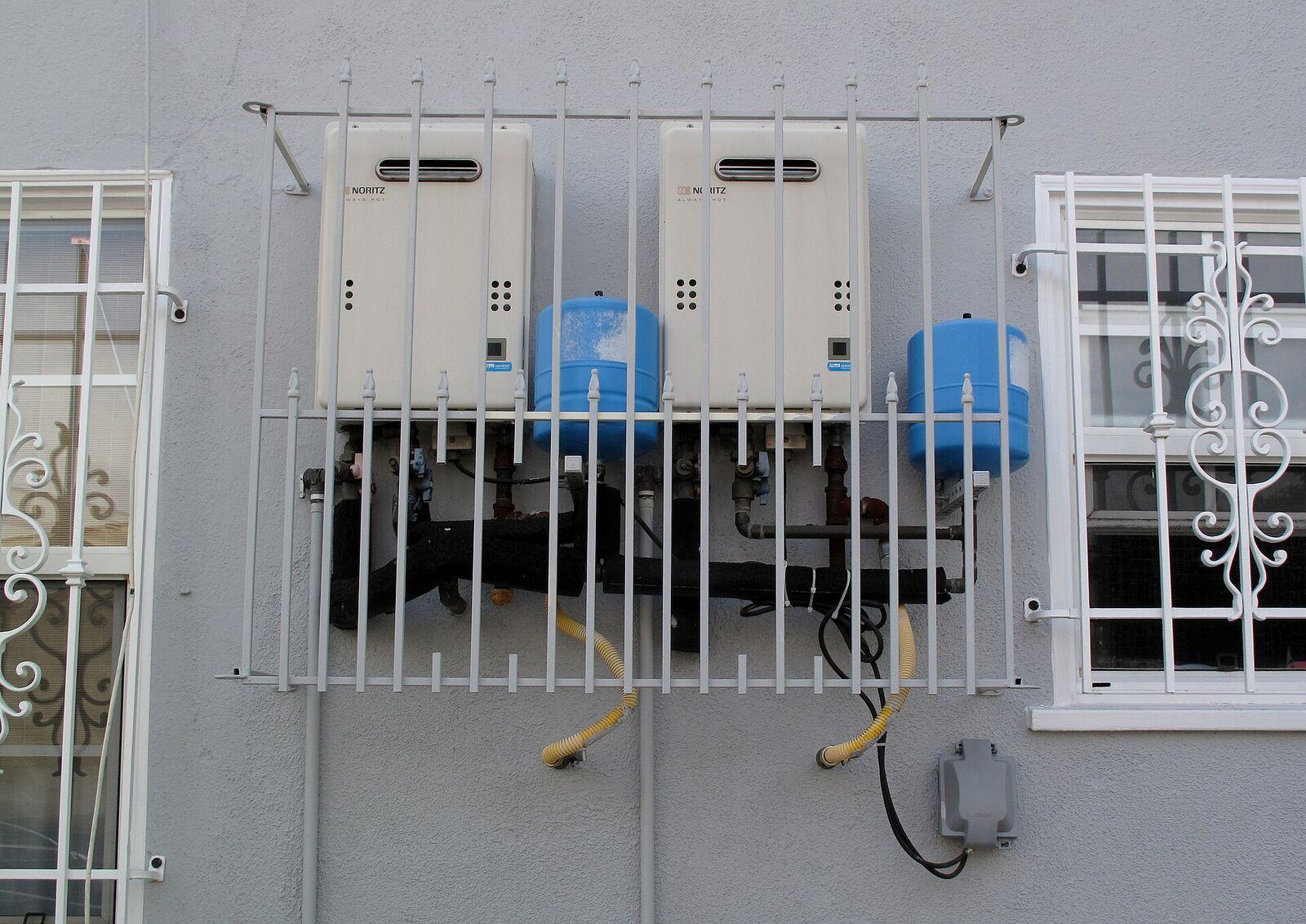
A tankless water heater needs less upkeep than a tank, but it isn't maintenance-free. The one job that matters most is descaling (flushing) the heat exchanger, which Rinnai and Navien both put at least once a year, more often with hard water. Add a quick clean of the inlet water filter, a look at the air intake and vent, and a yearly check by a technician, and you give the unit its best shot at the 15 to 20 years A.O. Smith says tankless heaters typically last.
The short schedule
| How often | Job | Who |
|---|---|---|
| Every few months | Look at the unit: leaks, error codes, anything blocking the air intake or vent outside | You |
| Every 3 to 4 months | Clean the air intake filter (models that have one; Navien's NPE-2 manual gives this interval) | You |
| At least once a year | Descale (flush) the heat exchanger, then clean the inlet water filter | You, if you're handy, or a plumber |
| Once a year | Check of the gas connections, venting, ignition and electrical parts | Technician |
| Whenever a scale code appears | Flush, regardless of the date | You or a plumber |
"Once a year" is the floor, not the target. Navien says three things push the interval shorter: harder water, a higher temperature setting and more hot water use. A family of five in a hard-water town may need to flush every six months; a couple on softened water might be fine at twelve.
Why tankless units need descaling
A tankless heater warms water as it rushes through a compact heat exchanger. When hard water is heated, calcium and magnesium drop out and stick to the inside of those passages, just as they do in a coffee maker. Navien explains that the buildup reduces efficiency and flow, lowers performance and can lead to overheating and premature failure.
Two things make this more than a nice-to-have:
- Warranty. Rinnai states plainly that damage caused by lime buildup isn't covered, and A.O. Smith's own guide calls hard water the biggest threat to a tankless unit's life.
- The heat exchanger is the expensive part. Scale that's flushed out every year costs some vinegar. Scale that's left for five years can cost you the unit.
Signs it's overdue
- A scale or lime warning on the display. On Rinnai units that's an LC or 00 code, which Rinnai links to lime buildup in the heat exchanger.
- Hot water that swings from hot to cold, or won't get as hot as it used to.
- Noticeably weaker hot water flow at the taps.
- Banging, rumbling or popping from the unit. A.O. Smith lists noise as a common sign of mineral buildup.
If you see any of these and you've never flushed the unit, flushing is the first thing to try.
What you need for a flush
Most units are flushed the same basic way: a small pump pushes a descaling liquid in through the cold side, it circulates through the heat exchanger and drains back out of the hot side into the bucket, round and round.
- Isolation (service) valves on the hot and cold lines with small hose ports. Most professional installs have them. If yours doesn't, a plumber has to add them first, and that's worth doing once.
- A bucket of 5 gallons or more.
- A small circulating or submersible pump. Rinnai's technical bulletin for its Sensei models recommends about 4 gallons per minute. A big, powerful pump isn't better here.
- Hoses: usually three, or two with a submersible pump. Washing-machine hoses fit most service ports.
- The cleaning solution: Rinnai calls for about 4 gallons of undiluted, food-grade white vinegar and warns against using other chemicals, because the same water ends up in your shower and kitchen. Navien allows white vinegar or an approved descaling solution.
How a flush works, step by step
This is the common sequence from Rinnai's and Navien's procedures. Valve names and a few details differ by model, so keep your own manual open next to you.
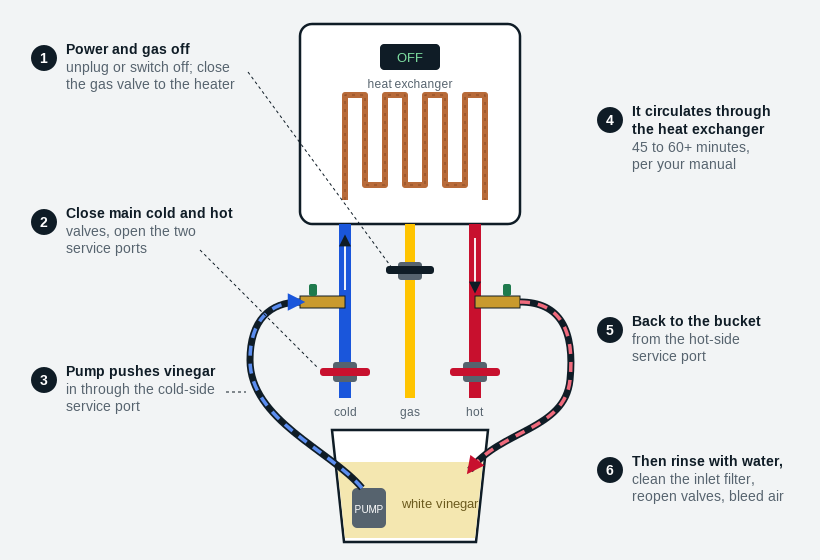
- Turn the unit off and disconnect power. On a gas model, also close the gas valve to the heater.
- Close the main hot and cold shutoff valves so household water can't flow in or out.
- Connect the hoses: pump outlet to the cold-side service port, a drain hose from the hot-side service port into the bucket, and the pump inlet into the bucket (or drop a submersible pump straight into it).
- Pour the vinegar or descaler into the bucket.
- Open the two service ports and switch on the pump.
- Let it circulate. Navien's manual and Rinnai's Infinity procedure say at least 45 minutes; Rinnai's Sensei bulletin says at least an hour at 3 to 4 gallons per minute. If the flow drops a lot, Rinnai suggests pausing to clean the inlet filter, then carrying on.
- Turn the pump off and rinse. Move the drain hose to a sink or floor drain, open the cold supply and let fresh water run through the unit. Rinnai says five minutes; Navien's descaling guide says at least ten.
- Clean the inlet water filter (see below) and put it back.
- Close the service ports, reopen the main valves, remove the hoses and replace the port caps.
- Restore power and gas, then open a hot tap slowly and let it run until the sputtering stops and the air is out of the line.
- Throw away the used vinegar. Rinnai says not to reuse it.
On some Rinnai Sensei models there's an extra preparation step before the flush: unplug the unit until the display goes dark, plug it back in for 20 seconds, then unplug it again. That positions internal valves for flushing, and the bulletin notes the on/off button doesn't do the same thing. It's a good example of why the model manual matters.
The filters people forget
Inlet water filter
Where cold water enters the heater there's a small mesh screen that catches grit and scale flakes. When it clogs, hot water flow drops even though the heat exchanger is fine. Both Rinnai and Navien have you clean it right after a flush, and Navien's manual describes rinsing it under cold running water and scrubbing it with a brush if needed. Close the water supply and drain the unit before you take it out.
Air intake filter
Some condensing units pull combustion air through a removable filter. Navien's NPE-2 manual says to clean it every three to four months, with a toothbrush and running water, and to let it dry fully before putting it back. A dusty filter in a garage or laundry area clogs faster.
Outside the unit
- Vent and air intake terminals. Gas tankless heaters vent outdoors. Keep the openings clear of snow, leaves, nests and stored stuff, and never block them.
- Condensate drain (condensing models). These units produce water that drains to a floor drain or a small pump. A kinked or clogged line can shut the heater down.
- Leaks and corrosion. A.O. Smith lists leaks around the unit as a sign seals or metal parts are failing. Drips from a valve or fitting are worth fixing before they get worse.
What to leave to a technician
A.O. Smith recommends having a certified technician check the heat exchanger, the ignition system on gas models and the electrical connections every year. Also call a pro for any gas smell, venting problem, error code that returns after a flush, or a leak from inside the cabinet.
Navien's own advice is that descaling can be done by a homeowner with the right equipment and skills, but that a wrong flush can void the warranty, and it recommends a professional. If you've never worked with valves and hoses, paying for the first flush and watching how it's done is a reasonable middle path.
Cutting down on scale
- Soften hard water. Lennox cites the EPA definition of hard water as more than 7 grains per gallon (120 mg/L). A.O. Smith recommends a whole-home softener for conventional tankless units in hard water.
- Don't run the temperature higher than you need. Navien lists a higher set temperature as one reason to flush more often.
- Scale prevention systems. Some manufacturers sell their own in-line treatment (for example Navien's PeakFlow and A.O. Smith's X3 technology) that they say reduces or removes the need to descale.
When maintenance isn't the problem
If your tankless unit is giving you no hot water at all, rather than slowly getting worse, check that power and gas are on and look up the error code in your manual before you buy a pump. And if you're trying to decide whether an old heater is worth maintaining, our guide to how long water heaters last covers the warning signs and the repair-or-replace math. Tank heaters with a standing pilot have their own problems: see pilot light won't light. All topics: water heater troubleshooting.
Questions people ask
How often should I flush a tankless water heater?
At least once a year, according to both Rinnai and Navien. Navien adds that hard water, a high temperature setting and heavy hot water use all mean flushing more often. If your unit shows a scale warning code, flush it then, whatever the calendar says.
Can I use vinegar to flush my tankless water heater?
Usually yes. Rinnai's procedures call for undiluted, food-grade white vinegar, about four gallons, and warn against other chemicals. Navien allows white vinegar or an approved descaling solution. Check your own manual first, since some manufacturers specify their own cleaner.
What happens if I never flush it?
Minerals keep building up inside the heat exchanger. Navien says that cuts efficiency and flow, can cause overheating and early failure, and both Rinnai and Navien exclude scale damage from their warranties. It's the most common reason a tankless unit dies young.
How long does a tankless flush take?
Plan on about an hour and a half. The cleaning solution circulates for at least 45 minutes on Navien and Rinnai Infinity units and at least an hour on Rinnai's Sensei models, followed by a rinse with fresh water and a filter clean.
Do I need a water softener with a tankless water heater?
Not always, but in hard water areas it helps. A.O. Smith recommends a whole-home softener for conventional tankless units in hard water. The EPA threshold Lennox cites for hard water is above 7 grains per gallon (120 mg/L).
Sources
- Rinnai: 13-step tankless water heater flushing procedure
- Rinnai Technical Bulletin 188: Optimized flushing procedure for SENSEI tankless water heaters (PDF)
- Rinnai: INFINITY maintenance, flushing the heat exchanger (PDF)
- Navien NPE-2 User's Information Manual (PDF)
- Navien: How to descale tankless water heaters
- A.O. Smith: How long do tankless water heaters last?
- Lennox: How long can a water heater last?
Written by the Why It Stopped editorial team from the manufacturer manuals and safety guidance listed above. It covers checks a homeowner can do safely; gas lines, refrigerant and sealed components are work for a licensed technician. See our editorial policy and safety disclaimer.
Other water heater problems
How long do water heaters last, and how to tell yours is near the end
Lifespan by type, how to read your heater's age, warning signs, and the repair-or-replace rule of thumb.

Why your water heater pilot light keeps going out
Lights, then dies: timing points to the thermocouple, drafts, a dirty pilot or the gas supply.
Water heater pilot light won't light: what's stopping it
No flame at all when you try to light it: gas supply, igniter, clogged pilot or a tripped safety device.
Pilot light is on but no hot water: why the burner isn't doing its job
Pilot burning, water cold or lukewarm: the main burner, the temperature dial, gas pressure, demand or the dip tube.