Goodman furnace error codes: what EE0, EE2, EE3 and the rest mean
Why It Stopped editorial team, updated
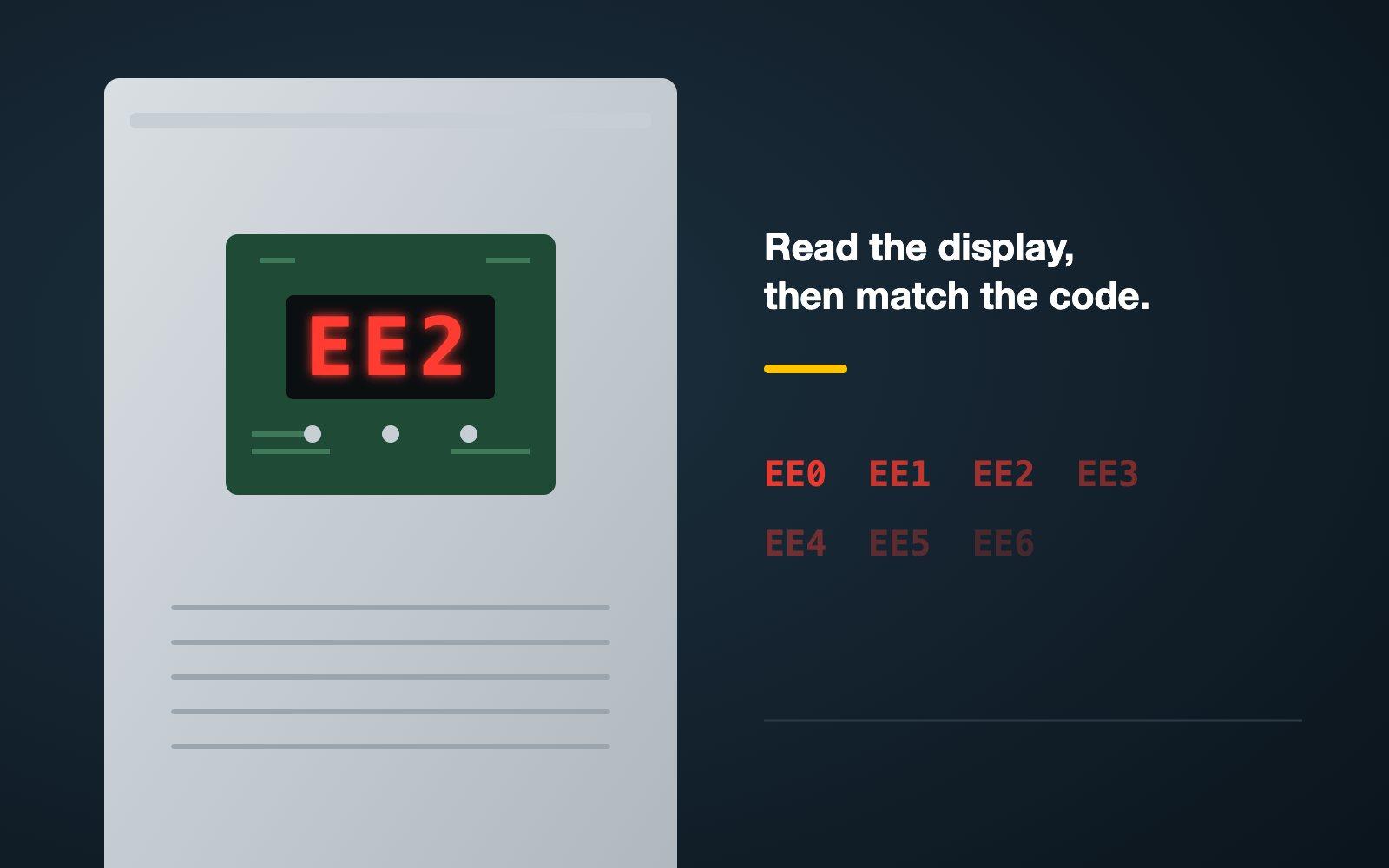
Current Goodman furnaces show faults as a code on a small display on the control board instead of a count of flashes. In Goodman's service manuals for the GR9S80, GM9C80 and GM9S92/96, EE0 is a lockout after three failed ignition tries, EE1 and EE2 are pressure switch faults, EE3 is an open limit and EE6 is a weak flame signal. The same codes apply to the matching Amana models. A few you can check yourself; most point to a technician.
Which Goodman furnaces use these codes
The codes here come from Goodman's service and troubleshooting manuals for three current families. The model number is on the rating plate inside the furnace.
| Model family | What it is |
|---|---|
| GR9S80, GD9S80 (Amana AR9S80, AD9S80) | 80% single-stage |
| GM9C80, GC9C80 (Amana AM9C80, AC9C80) | 80% two-stage |
| GM9S92, GM9S96, GC9S96 (Amana AM9S92, AM9S96, AC9S96) | 90%+ single-stage condensing |
These furnaces have a small display on the control board. In normal operation it shows the furnace's status (idle, heating, cooling, fan). When something's wrong it shows a code such as EE2. Older Goodman furnaces have a single light that blinks a count instead, and that count doesn't map one-to-one to these numbers (see the questions at the end) and our general furnace blinking red light guide.
Write the code down before you do anything else: Goodman's own troubleshooting starts from it.
The core codes: EE0 to EE6
These seven appear in all three Goodman manuals. The "what you'll notice" column is the symptom Goodman lists next to each code, which helps if you can't see the display.
| Code | What Goodman's chart says | What you'll notice |
|---|---|---|
| EE0 | Lockout after too many ignition retries (3 total): failed to light, or lost the flame | Furnace won't run |
| EE1 | Pressure switch closed at the start of the heating cycle: sticking contacts or a short in its wiring | Furnace won't run |
| EE2 | Pressure switch circuit not closed | Inducer fan runs nonstop, no heat |
| EE3 | Primary limit circuit open | House blower runs nonstop, no heat |
| EE4 | Flame sensed with no call for heat | Inducer and house blower run nonstop |
| EE5 | Open fuse, or a short in the low-voltage wiring | No furnace operation |
| EE6 | Weak flame signal (low microamps) | Furnace still runs, for now |
EE0: ignition lockout
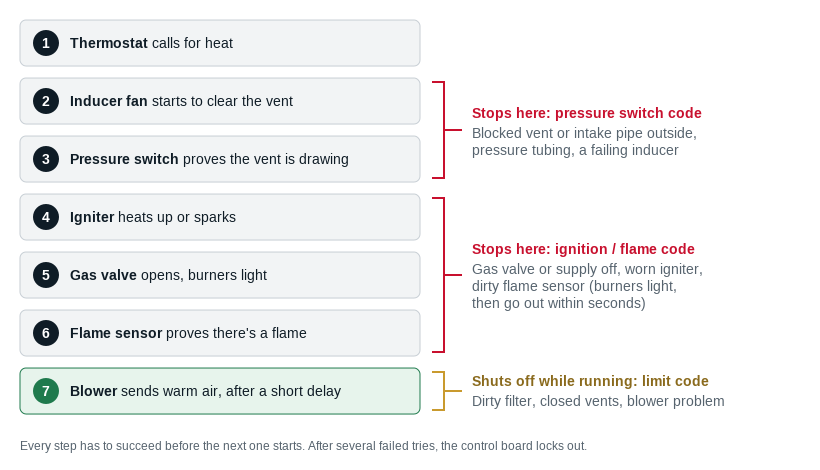
The furnace tried three times and couldn't light, or lit and lost the flame. Goodman's corrective list: find and fix any gas interruption, replace or realign the igniter, check the flame signal and clean the sensor if it's coated or oxidized, check the flue piping, and verify the inducer. Its EE0 flowchart names the usual suspects plainly: no gas or low gas pressure, a hot surface igniter that isn't glowing, and a dirty flame sensor.
What you can do: Goodman's first step is finding a gas interruption, so check that the manual gas shutoff valve on the line to the furnace is open. The igniter, sensor and gas pressure are for a technician.
EE1 and EE2: the pressure switch
Before the furnace lights, the inducer fan pulls air through it and the pressure switch must close to confirm the vent is drawing.
- EE1 is the opposite problem: the switch is already closed when the cycle starts. Goodman's fix is replacing the switch or repairing a short in its wiring. Technician.
- EE2 means it never closed. Goodman lists a pressure switch hose that's blocked, pinched or connected wrong, a blocked flue pipe, a weak inducer, a wrong set point or bad contacts, and loose wiring. On the 90%+ GM9S92/96 it adds a blocked inlet air pipe and a blocked drain system.
The part you can check for EE2 is outside: look at the vent and intake pipe ends for snow, ice, a nest or debris. On a condensing furnace, also check that the condensate drain line isn't blocked. The switch, hose and inducer are for a technician.
EE3: open limit
The limit opens when the heat exchanger gets too hot. Goodman puts filters and ductwork first: check for blockage, clean or replace the filter, remove obstructions. Its other causes are the wrong blower speed, a failed blower motor and loose wiring in the limit circuit. If a clean filter doesn't fix it, call.
Goodman's manual has a related warning for the auxiliary limit on some models: reset it only once, and if it opens a second time, a qualified servicer has to find out why before it's reset again.
EE4, EE5 and EE6
- EE4: flame detected when the gas should be off. Goodman lists a short in the flame sensor circuit, a lingering flame or a slow-closing gas valve. Technician, and promptly.
- EE5: an open fuse on the control board or a short in the low-voltage wiring. Goodman's fix is to replace the fuse and find the short; a fuse that blows again means the short is still there. Our AC not turning on guide covers the same kind of blown low-voltage fuse.
- EE6: the furnace runs, but the flame signal is weak. Goodman's causes: a coated or oxidized flame sensor, a sensor out of position, or a lazy flame from wrong gas pressure or combustion air. Goodman lists the symptom as normal furnace operation: the furnace still runs, but the cause should be fixed. Our furnace blowing cold air guide explains the flame sensor.
The other codes
The GR9S80 manual lists more codes. Most are control or wiring faults with nothing for a homeowner to adjust.
| Code | What Goodman's chart says |
|---|---|
| EEL | Igniter circuit problem: igniter connected wrong or shorted, poor ground |
| EEA | Igniter relay fault on the control, reversed 115-volt polarity, or poor ground |
| EEb | Gas valve not energized when it should be |
| EEC | Gas valve energized when it shouldn't be |
| EEn | Igniter open |
| EEJ | Inducer relay error |
| EEH | Twinning error (two furnaces linked together) |
| EEE | Internal fault in the control board |
| E10 | Grounding fault or poor neutral connection |
| E11 | Rollout switch open |
| EbL | Blower motor drawing too little current after the heat-on delay; hard lockout |
| EbU | Blower motor drawing too much current during the inducer pre-purge; hard lockout |
| No display at all | No 115-volt or 24-volt power, a blown fuse or tripped breaker, or a dead control board |
E11, the rollout switch, deserves a word. On 80% furnaces it's a manual-reset safety switch on the gas manifold that opens if flame rolls out of the burner area, and Goodman notes the house blower then runs continuously. Its corrective steps are checking gas pressure, burner alignment and burner restriction. Don't keep resetting it: call a technician.
The R-32 codes (newer systems)
Goodman's newest GR9S80 manual includes codes for furnaces paired with an air conditioner or heat pump using R-32 refrigerant. In each case Goodman says the furnace stops heating and only the fan runs, because it's in mitigation mode:
| Code | Meaning |
|---|---|
| EAL | The R-32 sensor detected a refrigerant leak. Goodman says normal operation resumes once no leak is detected and a 5-minute delay has passed |
| EAF | The furnace lost communication with the R-32 sensor |
| EAS | The R-32 sensor detected a fault in itself |
| EAr | The A2L relay on the control board detected a fault |
For EAL, Goodman's corrective action is to investigate the indoor coil for a refrigerant leak, which is work for an HVAC technician.
Viewing and clearing stored codes
Goodman's boards keep a fault history. From the manuals:
- Press the left or right button on the control board until L 6 F appears.
- Press the center button to view the stored faults.
- To erase them, press and hold the center button for 5 to 30 seconds. The display flashes three dashes and returns to L 6 F.
Leave the history alone if you're calling for service: it's the first thing a technician will want to see.
Resetting the furnace
Goodman's two-stage manual says the control can be reset by cycling the 115-volt power to the furnace, at its switch or breaker. Reset once, after you've written down the code. If it comes back, the cause is still there: EE0 that keeps returning means ignition, gas or flame sensing; EE2 means the vent or pressure switch; EE3 means airflow or the blower.
When to call a pro
When you book, give the code and the model number from the rating plate; Trane gives the same advice for its own furnaces, and it applies to any brand. For other brands, see our Trane flash code guide and York flash code guide. All furnace topics: furnace troubleshooting.
Questions people ask
What does EE2 mean on a Goodman furnace?
The pressure switch circuit didn't close, so the furnace won't light; the inducer fan usually keeps running. Goodman's service manuals list a blocked, pinched or misconnected pressure switch hose, a blocked flue pipe, a weak inducer, a bad switch or loose wiring. On its 90%+ models Goodman adds a blocked inlet air pipe or drain system. You can check the vent and intake pipes outside; the rest is technician work.
What does EE0 mean on a Goodman furnace?
Lockout after too many ignition retries, three in total: the furnace failed to light or lost its flame. Goodman's troubleshooting points to no gas or low gas pressure, an igniter that doesn't glow, or a dirty flame sensor, and also says to check the flue piping and inducer.
What does EE3 mean on a Goodman furnace?
The primary limit circuit is open: the furnace overheated, usually from too little airflow. Goodman's first corrective step is to check the filters and ductwork for blockage. Other causes are the blower speed setting, a failed blower motor or loose wiring in the limit circuit. While it's open, the circulating blower keeps running.
How do I see old error codes on a Goodman furnace?
On the control board, press the left or right button until L 6 F appears, then press the center button to view the stored faults. Holding the center button for 5 to 30 seconds erases them; the display flashes three dashes to confirm.
My older Goodman furnace has a blinking light, not a display. Do these codes apply?
No. Older Goodman furnaces use a single light that flashes a count, and Goodman's manual shows that count can mean something different from the display number: on its single-stage 80% models, for example, six flashes indicates a tripped rollout switch. Use the chart on the inside of the blower door for those.
Sources
- Goodman: Service and troubleshooting, GR9S80/GD9S80 80% single-stage furnaces, RS6621301 (PDF)
- Goodman: Service and troubleshooting, GM9C80/GC9C80 two-stage furnaces, RS6621007R2 (PDF)
- Goodman: Service and troubleshooting, GM9S92/GM9S96/GC9S96 single-stage furnaces, RS6612022R1 (PDF)
- Trane: Furnace light blinking, what it means
Written by the Why It Stopped editorial team from the manufacturer manuals and safety guidance listed above. It covers checks a homeowner can do safely; gas lines, refrigerant and sealed components are work for a licensed technician. See our editorial policy, safety disclaimer and terms of use.
Other furnace problems
Furnace blinking red light: how to read what it's telling you
Count the flashes, find your model's chart, and see which group the code falls into.
Furnace blowing cold air: 8 causes and what to check first
Air moves but isn't warm: fan setting, filter, flame sensor, gas, condensate and ducts.
Furnace not turning on: 9 checks, in the order a tech would do them
Nothing happens at all: thermostat, power, filter, gas, vents, and lockout codes in order.
Furnace keeps turning on and off? How to tell what's causing it
Burners on and off every few minutes: filter, vents, thermostat, flue, then flame sensor, limit switch or an oversized furnace.
Trane furnace blinking red light: what each flash code means
XR80 and other Trane flash codes from Trane's own guides: lockout, pressure switch, limit, flame, and how to reset.
York furnace red light blinking: what 1 to 11 flashes mean
Red, green and amber flash codes from York's TM9E manual, with soft and hard lockouts explained.