York furnace red light blinking: what 1 to 11 flashes mean
Why It Stopped editorial team, updated
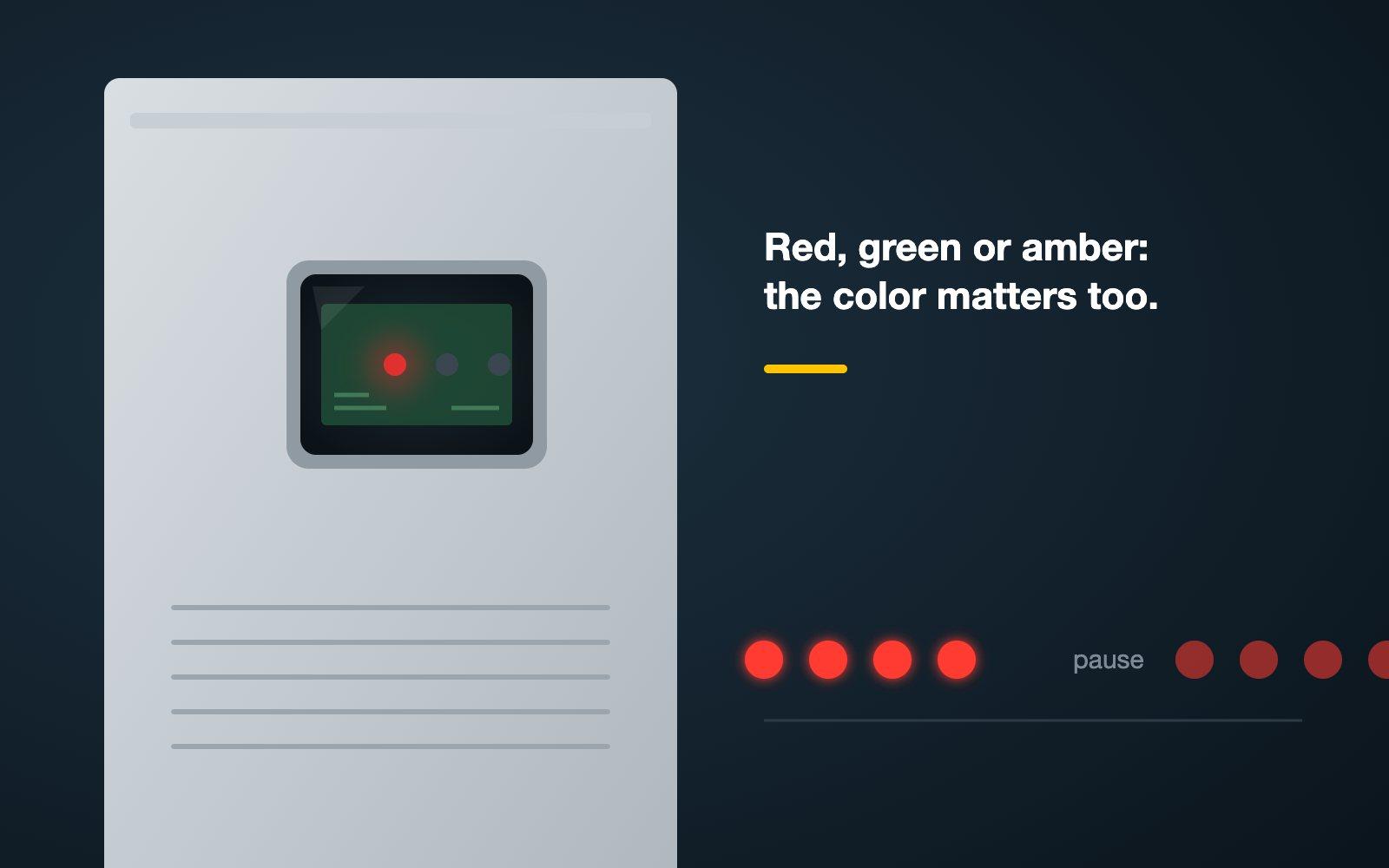
A York furnace shows its status with a light on the control board that flashes red, green or amber. Slow green means it's idle, slow amber means it's heating. A counted group of red flashes is a fault: in York's TM9E manual, 3 red flashes means the pressure switch didn't close, 4 means the main limit opened, 7 means the furnace couldn't light in three tries. Some faults clear themselves after an hour; others need the power turned off and on.
Read the color and the count
York's TM9E manual describes a single light on the control board that can flash in three colors. The timing tells you whether it's normal operation or a code:
- Slow flash (2 seconds on, 2 seconds off): normal status. Slow green means no call from the thermostat; slow amber means it's running on a call for heat.
- Fast flashes in a group (one third of a second on, one third off), then a 2-second pause, repeating: a fault code. Count the flashes in one group, and watch two or three groups to be sure.
- Steady on, any color: control failure. York says to turn the furnace power off and on; if the code returns, the control board must be replaced.
- Steady off: no power to the board, or a blown fuse on the board.
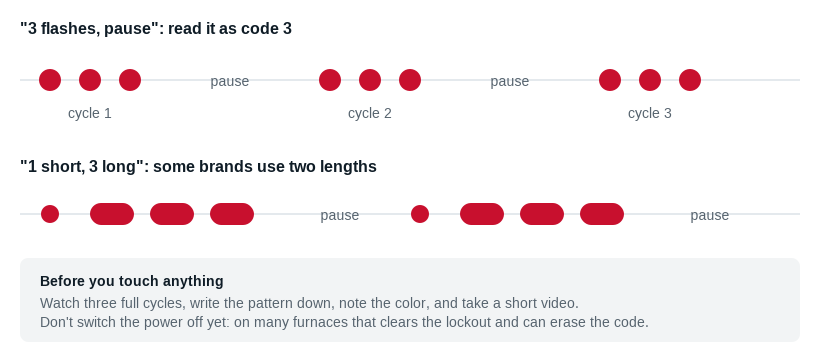
Write the code down before touching the power. York also warns never to run the furnace with the blower door removed.
York flash codes (TM9E)
These are the codes in York's TM9E installation manual (document 6019630-UIM-F-0423). Other York furnaces may use a different board: if your model number isn't a TM9E, compare against the chart on the inside of the blower door before relying on this table.
| Code | What York's manual says | Who handles it |
|---|---|---|
| Slow green | Normal, no thermostat call | — |
| Slow amber | Normal, call for heat | — |
| 1 red | Flame sensed with no call for heat; York says check for a leaking or slow-closing gas valve | Technician |
| 2 red | Pressure switch closed when it should be open | Technician |
| 3 red | Pressure switch open when it should be closed | Check the vent outside, then technician |
| 4 red | Main limit switch opened | Filter and airflow first |
| 5 red | Rollout switch opened (manual reset) | Technician |
| 6 red | Pressure switch opened four times during one call for heat | Vent outside, then technician |
| 7 red | No flame after three tries for ignition | Gas checks, then technician |
| 8 red | Flame lost five times during one heating cycle | Technician |
| 9 red | Reversed polarity, grounding problem or reversed low-voltage transformer wires | Electrician or technician |
| 10 red | Gas valve energized with no call for heat | Technician |
| 11 red | Main limit open for more than 5 minutes, usually a failed blower motor or blower wheel | Technician |
| 4 amber | Cooling signal (Y) without fan signal (G): thermostat wiring | Technician or installer |
Soft lockout and hard lockout
York's control has two kinds of lockout, and knowing which one you're in saves a lot of confusion:
- Soft lockout resets itself after one hour. York's example is a temporary interruption in the gas supply: the control keeps trying to light each hour and goes back to normal once gas is restored. Codes 6, 7 and 8 lead to a one-hour lockout, and so does a main limit that opens five times in one call for heat (shown as 4 red flashes).
- Hard lockout doesn't restart by itself. Power to the control has to be turned off and back on, after the problem has been fixed. York lists the rollout switch (5 red) and a limit that stays open more than five minutes (11 red) as hard lockouts.
So a furnace that comes back on its own an hour later wasn't fixed: it was in a soft lockout and tried again. If it happens repeatedly, the cause is still there.
What you can check yourself
Before calling, York's manual lists four visual checks for anyone troubleshooting the furnace. You can do all of them without opening anything:
- Power is on to the furnace: breaker and the furnace's own switch.
- The manual gas shutoff valves in the gas line to the furnace are open.
- Wiring connections are secure, as far as you can see without removing panels.
- Start a heating cycle by setting the thermostat above room temperature, and watch what the furnace does.
3 red flashes: pressure switch open
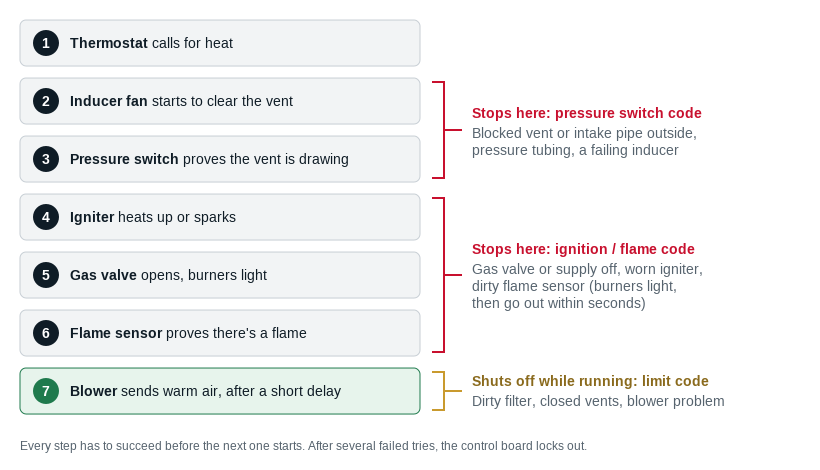
The inducer fan has to pull enough draft through the furnace for the pressure switch to close before ignition. If it doesn't, the furnace stops with 3 red flashes. York lists a faulty inducer, a blocked vent pipe, a broken pressure switch hose, disconnected wires and a faulty pressure switch.
The part you can check is the vent pipe outside: snow, ice, a nest or debris at the pipe end can block it. If the code shows 6 red flashes instead, the switch closed but kept opening while the furnace ran, four times in one call for heat; York points to a faulty inducer, a blocked vent pipe or a faulty pressure switch. York's manual also warns never to adjust the pressure switch to make the furnace run.
4 and 11 red flashes: the limit switch
The main limit opens when the furnace overheats. York's list for 4 red flashes starts with a dirty filter, then an incorrectly sized duct system, the wrong blower speed or firing rate, loose limit wiring or a faulty blower motor. While the limit is open, the control keeps the supply air blower and the inducer running.
Replace the filter if it's dirty; the rest of York's list is technician work. If the limit stays open for more than five minutes, York's control treats it as a blower failure and switches to 11 red flashes and a hard lockout. York says this is usually a failed blower motor or blower wheel, which needs a technician.
7 and 8 red flashes: ignition and flame
Seven flashes means no flame after three tries. York's first check is the gas valve switch: make sure it's in the ON position. After that, York's list (low or no gas pressure, the gas valve, the flame sensor, the hot surface igniter, loose wires, the burners) is for a technician.
Eight flashes means the burners lit but the flame was lost five times in one heating cycle. York points to low gas pressure, a dirty or faulty flame sensor, or the gas valve. Carrier explains that carbon buildup or oxidation on the flame sensor rod is the usual reason a furnace can't confirm its flame; our furnace blowing cold air guide covers the flame sensor in more detail.
The LAST ERROR button
The control remembers the five most recent error codes, even through a power loss. Pressing the LAST ERROR button plays them back, newest first, with a 2-second pause between codes; two green flashes mean the memory is empty, and holding the button for more than 5 seconds clears it. York's manual is clear that this feature is for a qualified service technician, and it only works when there's no call for heating, cooling or fan. If you're booking a repair, mention that the board has stored codes.
When to call a pro
When you call, give the color and number of flashes and the furnace's model number; Trane gives the same advice for its own furnaces, and it applies to any brand. Not a York? Our Trane flash code guide and the general furnace blinking red light guide cover other boards. All furnace topics: furnace troubleshooting.
Questions people ask
What does 3 red flashes mean on a York furnace?
The pressure switch contacts are open when they should be closed, so the furnace won't continue its start-up. York's TM9E manual lists a faulty inducer, a blocked vent pipe, a broken pressure switch hose, disconnected wires or a faulty pressure switch. You can check the vent pipe outside for blockage; the rest is for a technician.
What does 7 red flashes mean on a York furnace?
The furnace couldn't establish a flame in three tries for ignition. York says to check that the gas valve switch is on, then lists low or no gas pressure, a faulty gas valve, a dirty or faulty flame sensor, a faulty hot surface igniter, loose wires or a burner problem. The furnace locks out for an hour and then tries again.
My York furnace is flashing amber. Is that a fault?
A slow amber flash is normal: the furnace is running on a call for heat. Four amber flashes is different: York says the control is getting a cooling signal (Y) from the thermostat without a fan signal (G), a wiring problem. The furnace still heats and cools, but the G wire should be checked.
How do I reset a York furnace?
For a hard lockout, York says power to the control has to be turned off and back on after the problem is fixed. Soft lockouts reset themselves after one hour. If the same code returns after one reset, call a technician rather than cycling the power again.
What is the LAST ERROR button on a York furnace board?
It plays back up to five stored error codes, newest first, and holding it for more than five seconds clears them. York's manual says this feature must only be used by a qualified service technician, and it only works when there's no call for heat, cooling or fan.
Sources
- York (Johnson Controls Ducted Systems): TM9E single-stage gas furnace installation manual, 6019630-UIM-F-0423 (PDF)
- Carrier: Furnace flame sensor
- Trane: Furnace light blinking, what it means
Written by the Why It Stopped editorial team from the manufacturer manuals and safety guidance listed above. It covers checks a homeowner can do safely; gas lines, refrigerant and sealed components are work for a licensed technician. See our editorial policy, safety disclaimer and terms of use.
Other furnace problems
Furnace blinking red light: how to read what it's telling you
Count the flashes, find your model's chart, and see which group the code falls into.
Furnace blowing cold air: 8 causes and what to check first
Air moves but isn't warm: fan setting, filter, flame sensor, gas, condensate and ducts.
Furnace not turning on: 9 checks, in the order a tech would do them
Nothing happens at all: thermostat, power, filter, gas, vents, and lockout codes in order.
Furnace keeps turning on and off? How to tell what's causing it
Burners on and off every few minutes: filter, vents, thermostat, flue, then flame sensor, limit switch or an oversized furnace.
Goodman furnace error codes: what EE0, EE2, EE3 and the rest mean
EE0 to EE6, E10, E11, the blower and R-32 codes on current Goodman and Amana furnaces, from Goodman's service manuals.
Trane furnace blinking red light: what each flash code means
XR80 and other Trane flash codes from Trane's own guides: lockout, pressure switch, limit, flame, and how to reset.